* This article has been edited and reconstructed based on the report submitted to the Kawamura Foundation for the Promotion of Culture and Arts.
Hilos que Luchan, Manos que Sanan: NUESTRA JUSTICIA
[Application project]
Hilos que Luchan, Manos que Sanan: NUESTRA JUSTICIA
[Applicant]
Hilos que Luchan, Manos que Sanan
[Subsidy] 300,000 yen
[Overview]
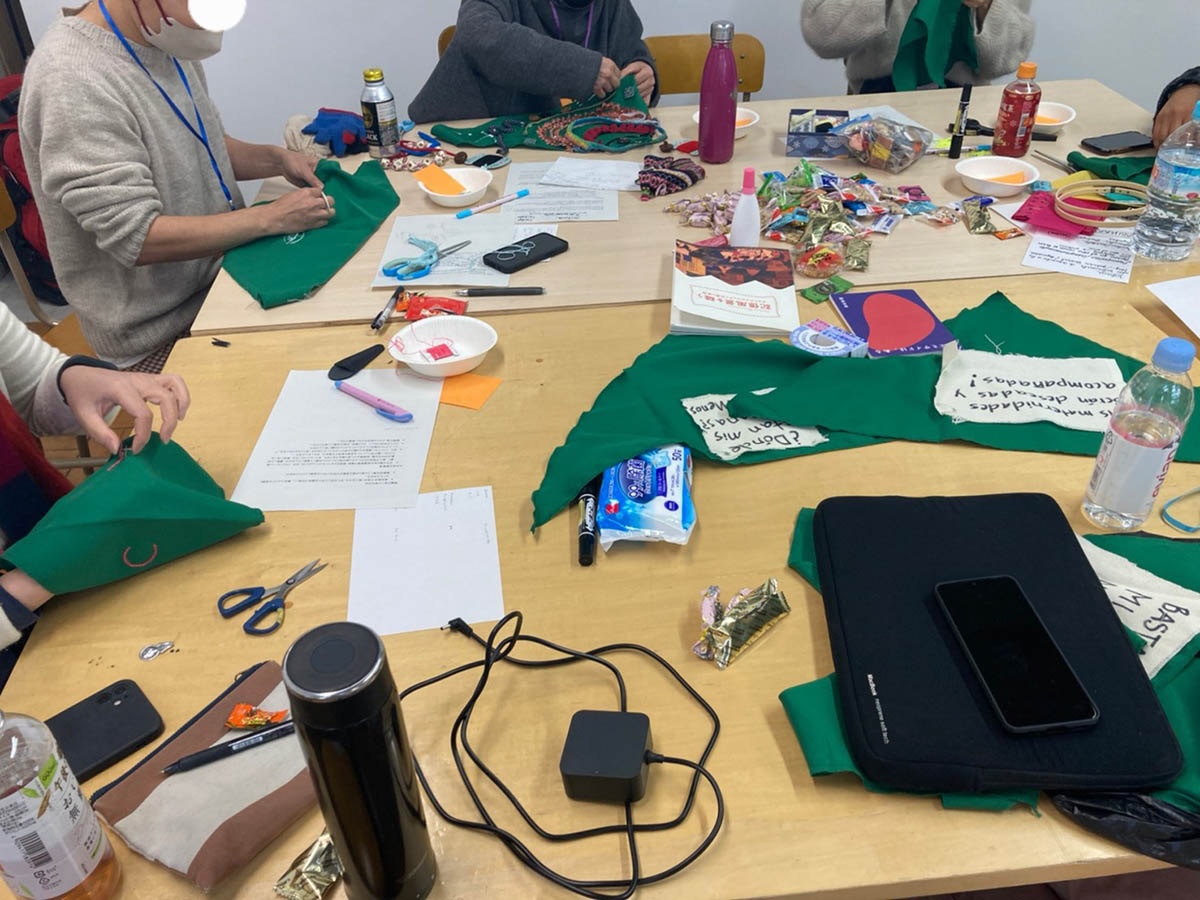
The Hilos que Luchan, Manos que Sanan workshop began together with participants of the online course “South American Feminist Art Activism,” organized by Kasumi Iwama. Iwama first gave a short talk on femicide and activism in Ecuador, South America, after which participants discussed the themes together. The content of these discussions was later reflected in the making of bandanas.
During the production process, participants continued conversations while working with their hands, and a wide range of topics emerged, including sexual harassment in workplaces and schools, molestation on public transportation, childcare, sexism, religion, the emperor system, discrimination in the art world, books, and films.
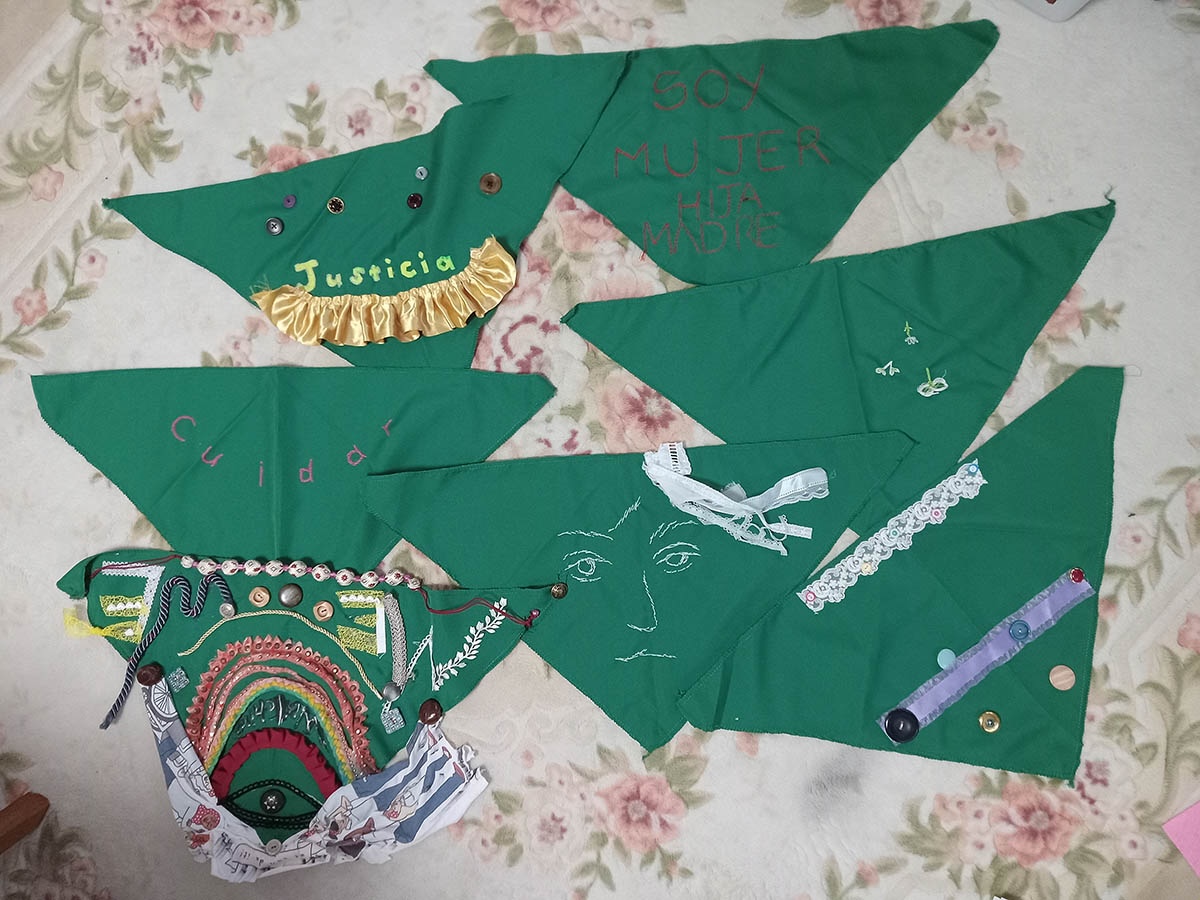
Despite the limited duration of only two hours, the green bandanas created through the workshop were completed with remarkable strength and presence. In addition to needles and thread, materials such as felt and beads were also provided, allowing both beginners and experienced participants alike to engage fully in the making process.
[Held / Implemented / Announced]
[Outcome]
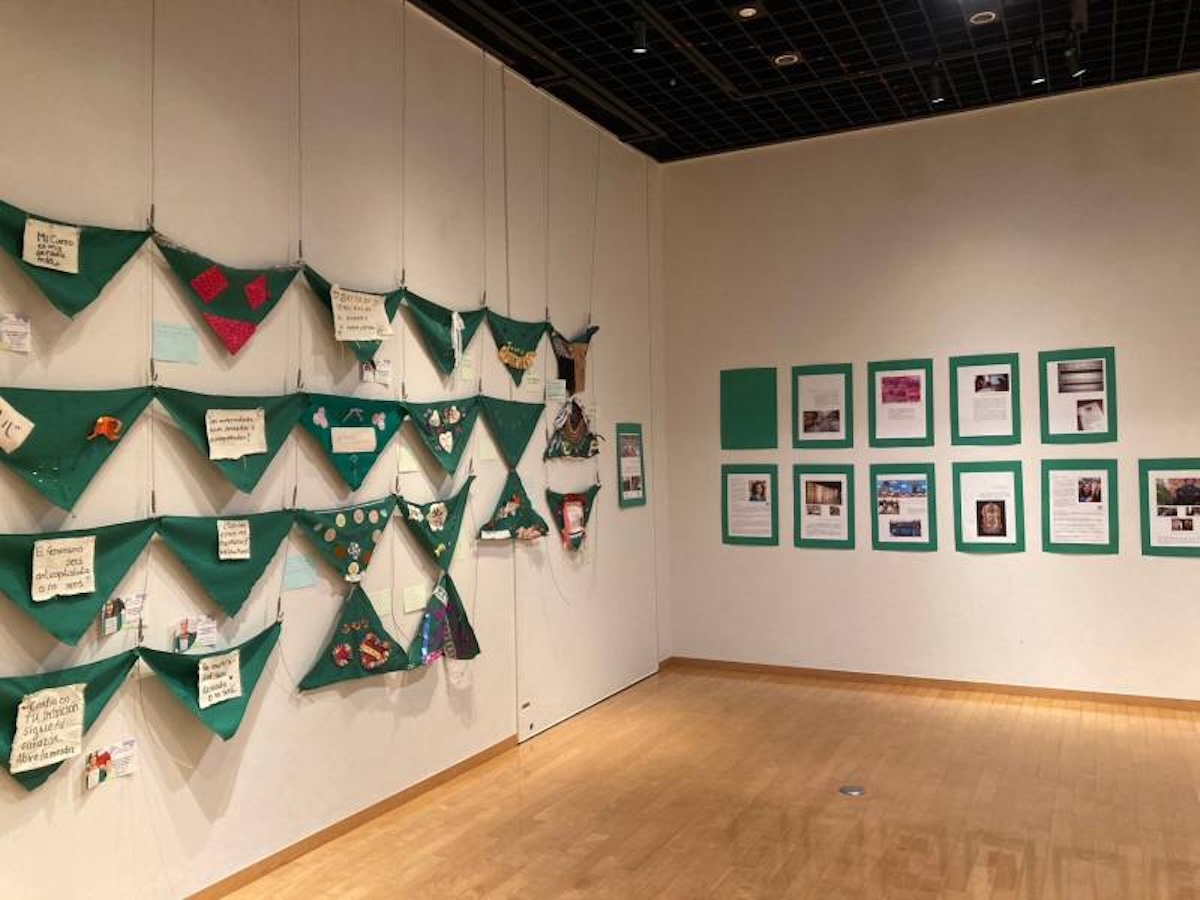
The workshop exhibition was held not only in Kariya City, Aichi Prefecture, but also for three days in Tokyo, where many people came to see it. We also stayed at the gallery together with Kasumi for one day, and throughout the day we were constantly talking with visitors, both acquaintances and people we had never met before, who came to the exhibition one after another.
At Irregular Rhythm Asylum (IRA), the infoshop in Shinjuku that hosted the exhibition, a secondhand book fair and event had just been held during Christmas of the previous year (2022), featuring books read by Toshihiko Kamata, a prisoner serving a life sentence in Miyagi Prison in connection with the “Christmas Tree Bombing Incident.” Around February, IRA had also just begun an initiative to write letters to incarcerated people. Because of this coincidental timing, conversations with Narita from IRA became very lively, touching on the discussion video between Kaori Sakagami and Mujeres de Frente, the violence inherent in incarceration, the treatment of incarcerated people, and how support could be offered from outside prison walls. Various thoughts and conversations that had previously felt like disconnected points suddenly connected within me, making me feel directly confronted with the question of what I myself could do.
Surrounded by green bandanas and immersed in various forms of expression, the workshop made Ecuador, a place across the ocean that I had never visited, feel incredibly close to me. Seeing the bandana works created in Japan, I hope that people in Ecuador might also feel something similar.(Kanna, Feminist Embroidery Group Yamamba)
Three and a half years have passed since the exhibition at Aichi Triennale 2019, yet unfortunately, our activities are still necessary. In other words, sexism and sexual violence have not disappeared. At the same time, through this project, we strongly felt that more and more people around the world are confronting these issues and empowering one another.
Many of the social issues discussed in the workshops and exhibitions resonated across both Latin America and Japan, creating opportunities for participants and audiences from both regions to share their experiences beyond national boundaries. We feel that this became a uniquely meaningful initiative unlike any other.
We strongly feel that we would like to continue these activities until sexism and sexual violence disappear from the world.(Momo, Our Clothesline with Mónica Mayer)
Hilos que Luchan, Manos que Sanan will continue its activities in the future. Interest in South American feminism has been growing among feminists in Japan; however, opportunities for exchange remain limited due to language barriers and physical distance. Precisely for this reason, we hope that this project, Hilos que Luchan, Manos que Sanan, which directly connects South American and Japanese feminisms without mediation through Europe or the United States, will continue to play an important role in the future.
Hilos que Luchan, Manos que Sanan
https://www.tatakauitonokai.com/