* This article has been edited and reconstructed based on the report submitted to the Kawamura Foundation for the Promotion of Culture and Arts.
The Island Atlas: Our Words for the Future of Our Homeland
[Application project]
The Island Atlas: Our Words for the Future of Our Homeland
[Applicant]
ELGUEDA WARD STUDIO (Ximena Elgueda & Stephen Ward)
[Subsidy] 300,000 yen
[Overview]
Island residents’ spiritual connection to their “hometown” is deeply tied to the foundation of their sense of self and existence. In this project, participants who all originated from Himeshima Island (Oita Prefecture) but had chosen different life environments engaged in remote dialogue and expressed the images that emerged through these exchanges onto maps, moving beyond the opposition between “imagination and reality.” The resulting maps became an atlas, forming a system of propositions concerning the future of the island and aiming to deepen understanding of both individual consciousness and the consciousness of the community as a whole.
ELGUEDA WARD STUDIO (EWS) believes that, within socially engaged art, artists can act as catalysts who encourage social participation through art rather than through political methods. In 2020, EWS carried out the Chair Project under the theme of “memories of one’s hometown” in order to record the fading memories of local people from multiple perspectives. Although many conversations about “memories of one’s hometown” also touched upon the future of the island, there appeared to be overall little sense of agency toward the future.
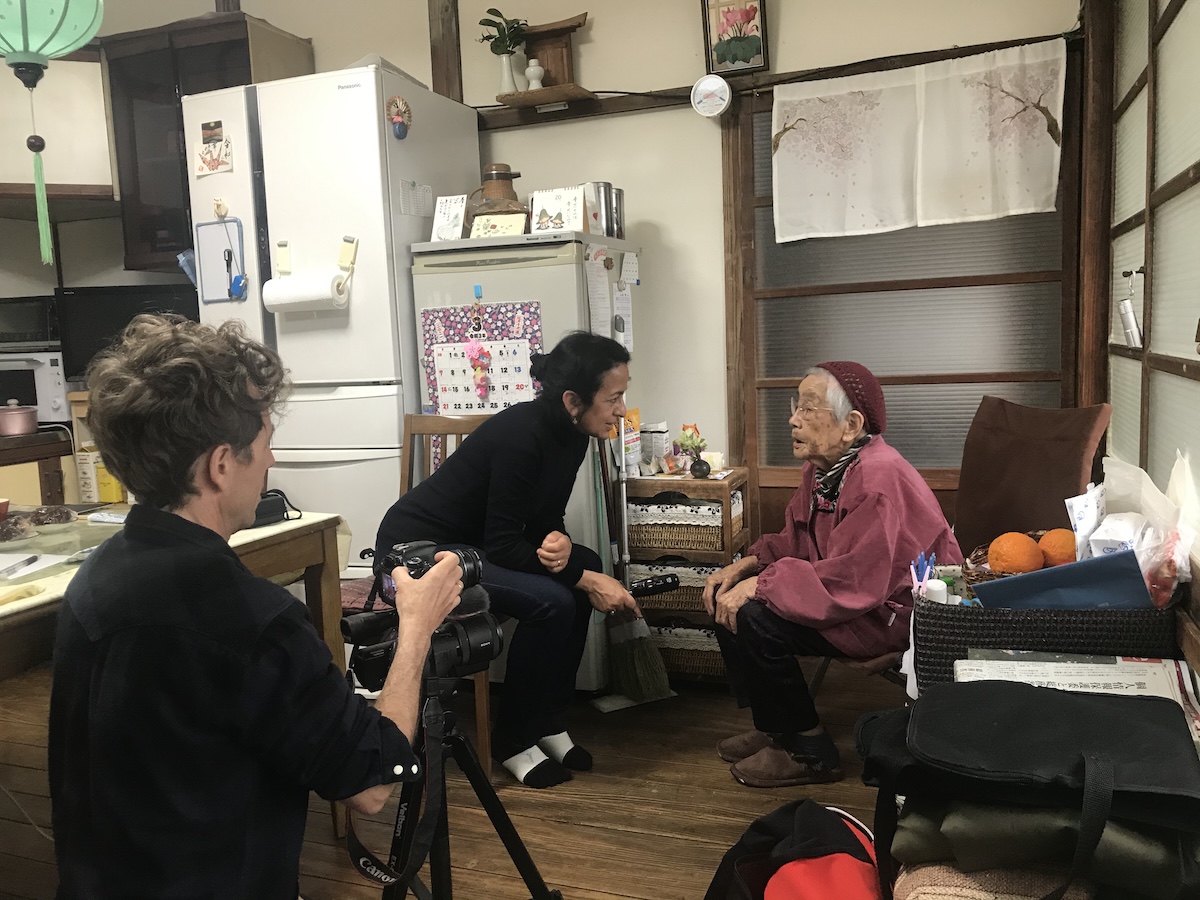
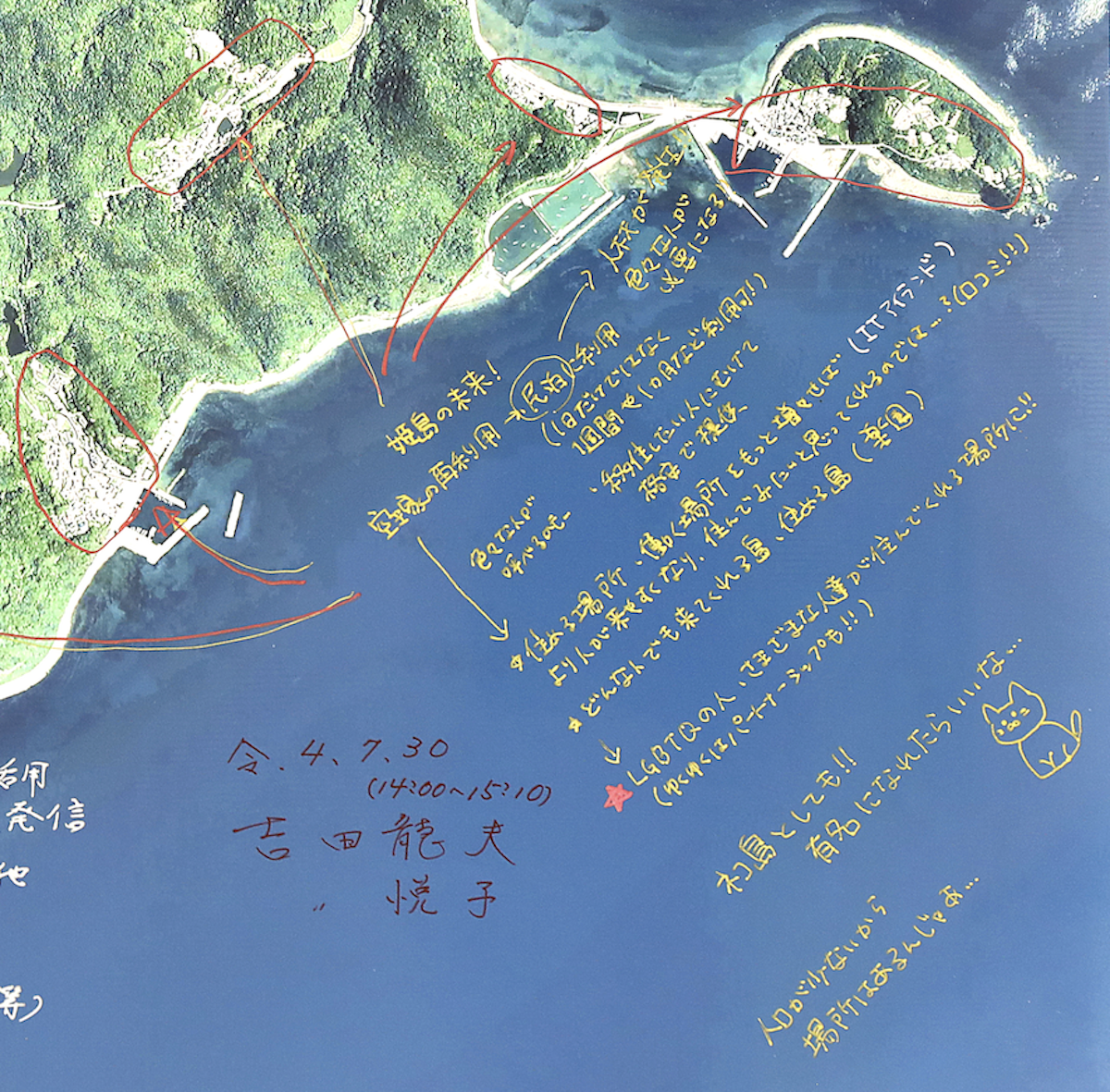
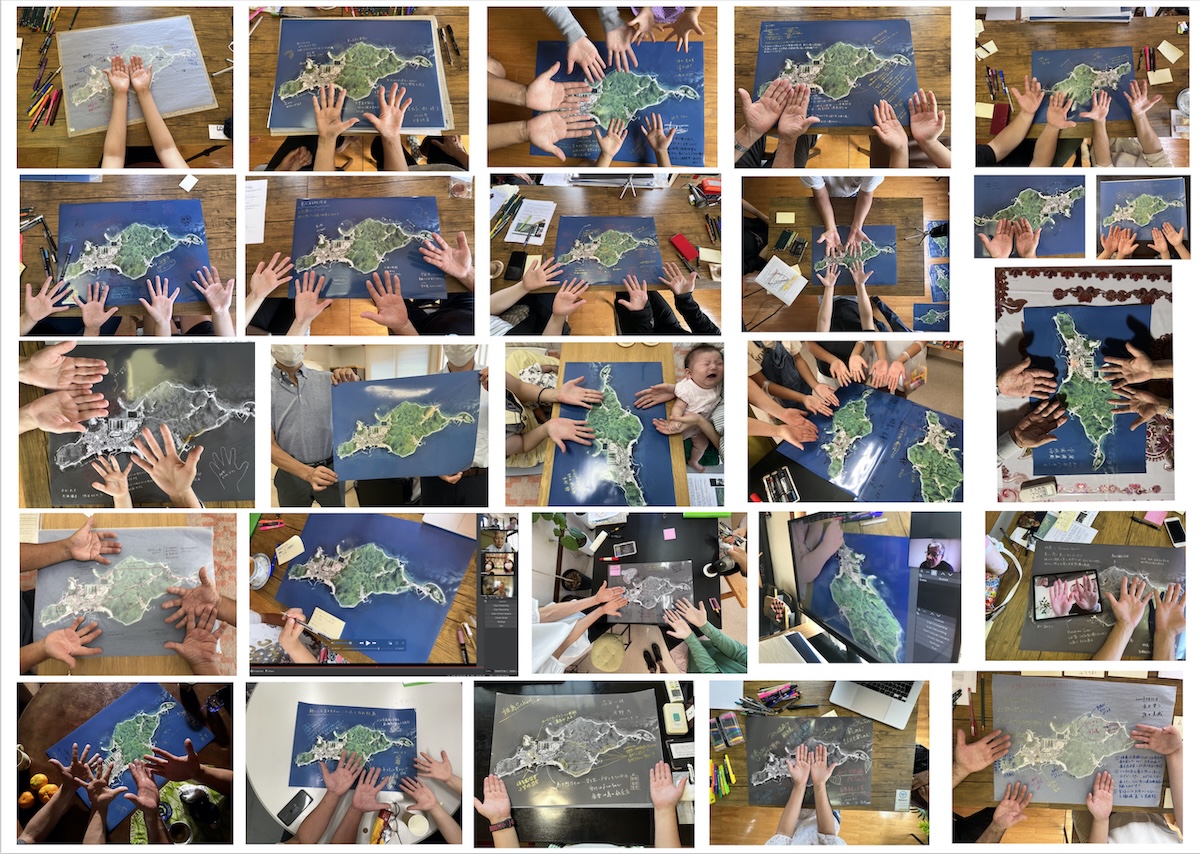
Through remote and in-person dialogue among people originally from Himeshima, participants shared their feelings and perspectives on the condition of the island from multiple angles and collaboratively created “future visions of Himeshima” based on an actual map of the island. Participants present on site took notes during the dialogues and, while confirming ideas together with the others, wrote down on an aerial map of Himeshima the “future visions” that emerged through the conversations.
[Held / Implemented / Announced]
• Industry
In Himeshima, kuruma-prawn fishing has become one of the island’s important industries. While some residents welcomed new businesses that could bring income to the island, others wished to preserve existing industries and ways of life.
• Younger Generation
Because there are limited industries in Himeshima, many people leave the island for work. In addition, public education on the island only extends through junior high school. For these reasons, the declining birthrate and aging population have progressed rapidly, making Himeshima the municipality with the highest average age in Oita Prefecture. Many younger residents expressed hopes for new young people to move to the island. Parents concerned about their children’s future also wished to expand educational options for them.
• Voluntary Cooperation from Residents
A local souvenir shop owner offered to cooperate with the project. Five maps were placed in the shop, and elementary and junior high school students who visited during the summer vacation were invited to write their visions of the island’s future, including their hopes and fears, directly onto the maps. They freely drew and wrote about facilities, playgrounds, and other things they wished to have on the island. Unlike the adult participants in the project, they did not arrive at conclusions through dialogue-based consensus around ideas or concepts that emerged during discussion.
However, according to the principal of the local elementary school, students were also discussing “the future of the island” in groups as part of their school assignments. Through the Atlas Project, elementary and junior high school students were able to interact with one another and freely express and write about their visions for the future of their island within a framework different from that of schoolwork.
• Difficulties and Challenges
In Himeshima, the village mayor holds strong authority, and although the Atlas Project was an independent project, we were initially told that we needed to meet with the mayor and obtain permission. Eventually, the staff of Ecotour introduced the project at the village office, and permission for the project was granted. Because EWS does not live in Himeshima, gathering participants was extremely difficult. Information about the project was shared in advance through social media and other means, but when the project first began, only two people expressed interest in participating. By actively reaching out to residents and with the cooperation of shop owners and people who had moved to the island, connections gradually formed, and ultimately 77 people participated in the dialogues.
In the previous project, the “Chair Project,” participants mainly spoke in an interview format. In this project, however, it was necessary to deepen the content of the dialogues among participants themselves and, at times, to guide the direction of the conversations.
• Flow of the Dialogue
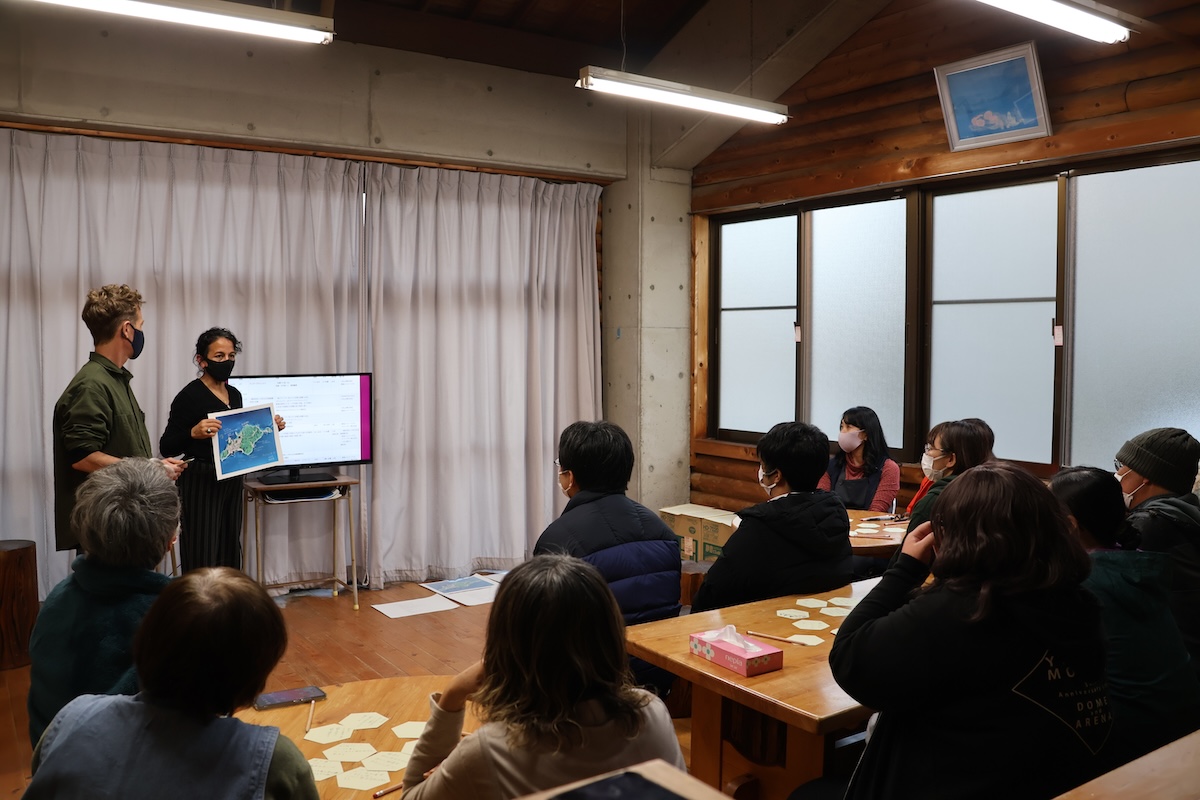
1.EWS and the participants introduced themselves to one another, after which EWS explained the project and its relationship to previous projects.
2.After explaining the project documentation process and the handling of personal information, EWS confirmed participants’ consent to take part in the project.
3.Participants discussed and decided on themes related to future visions of the island while confirming each other’s interests, and were then encouraged to speak freely. During this process, EWS provided questions and comments when necessary so that the dialogue would not diverge too far from the main subject.
4.Participants present on site wrote notes on Post-it notes and, while confirming ideas with their dialogue partners, summarized in writing the images and visions that emerged through the conversations onto maps of Himeshima.
5.Participants were asked to complete consent forms regarding the handling of personal information.
6.Finally, EWS shared information about future project reports, exhibitions of the maps, and the website and social media platforms through which the project could be followed.
●Research Overview
◯ Number of Participants and Completed Maps
For “Island Atlas: Our Words Are the Future of Our Hometown,” 29 maps envisioning the future of Himeshima were created through the participation of 77 people ranging in age from 3 to 80 years old. Participants included 58 people originally from Himeshima or currently living on the island, 10 people living on the mainland, and 9 others, including migrants to the island. Each dialogue session lasted between 45 minutes and 3 hours.
◯ Dialogue Content
Through repeated dialogue, participants were able to imagine the future of their island and environment. Discussions mainly focused on public spaces such as parks, the island’s natural environment, and tourism facilities. One group focused on how to create public spaces where island residents and tourists could gather together. Another group focused on making use of existing public spaces on the island and exchanged ideas regarding maintenance and repair.
In a dialogue between two people who had moved to the island, ideas were discussed about transforming the island into “an ideal image of near-future Japan.”
Regarding the island’s environment, some participants viewed nature as part of their everyday lives and wished to protect it, while others proposed attracting tourists by partially developing forested areas to construct new infrastructure such as hotels and golf courses.
Most island residents did not rely heavily on shopping and often ate seafood they had caught themselves and vegetables they had grown. For this reason, fishing and agriculture became frequent topics of discussion.
Regarding fishing, participants mainly discussed the recent decline in seafood populations. Some island residents believed that the sea had become too clean, resulting in a lack of nitrogen needed to sustain plankton, which they considered one of the main causes of declining fish populations. Others spoke about the effects of global warming, “the end of the fishing industry,” and the need for space and technology for fish farming.
Regarding agriculture, participants discussed damage to crops caused by wild boars. As wild boars swim over from the mainland in search of food and make cultivation difficult for island residents, ideas also emerged about preparing game dishes using boar meat.
● Feedback from Island Residents
“I was deeply moved to witness the thoughts and feelings of people living in the same community expressed so clearly. Perhaps this was the first time that individual thoughts and feelings had been presented in such a way. By respecting the principle of not criticizing the words and opinions expressed by others, I believe it became possible to achieve the kind of results seen in this project.” (Man in his 80s)
“I was reminded once again of the importance of many different people contributing ideas so that people can live happy and fulfilling lives on this island. From now on, I would like to help junior high school students grow into people who can propose such ideas and think seriously about the island.” (Man in his 50s)
“There were so many ideas filled with hope and expectation, and the energy conveyed through the words was truly exciting.”
(Woman in her 30s)
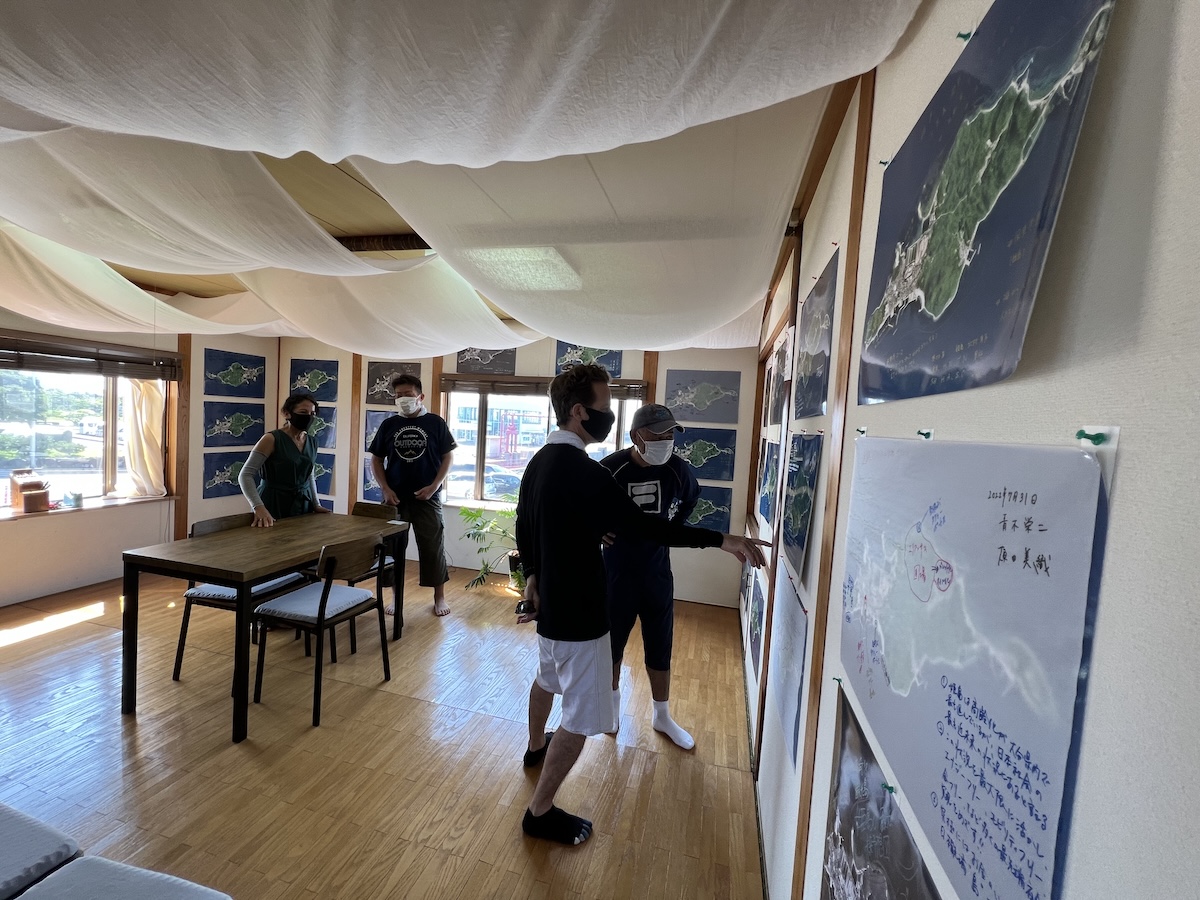
● Exhibition (29 Maps) | August 5 – December 1, 2022
<Venue> Second Floor, Himeshima Ecotourism
[Outcome]
The family of the current village mayor has held the position of mayor for more than fifty years across multiple generations, and some island residents expressed a desire for change. Residents in their thirties and employees of the village office tended to be cautious about expressing their opinions or revealing their identities out of concern for possible effects on their work.
Based on feedback from island residents regarding the project, EWS believes that Island Atlas was able to provide a neutral space and a framework for dialogue in which residents could speak about, discuss, and develop shared understandings regarding the future of their island.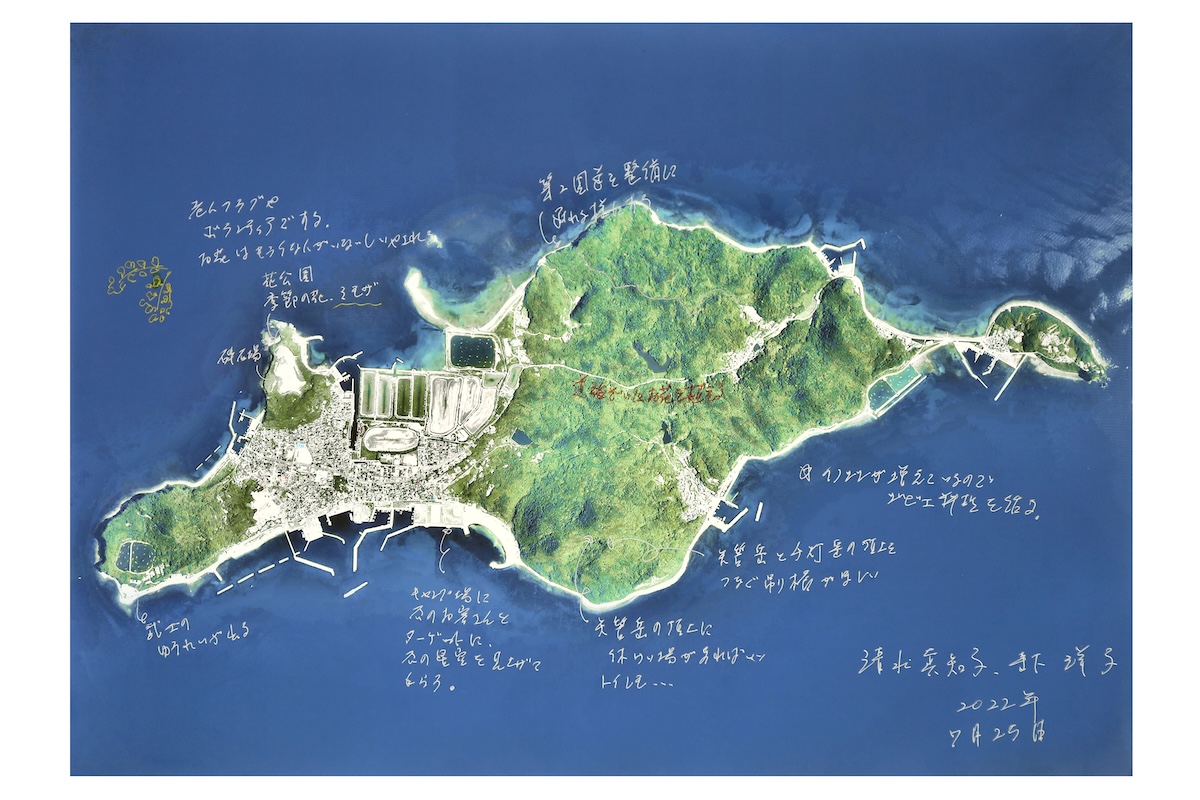
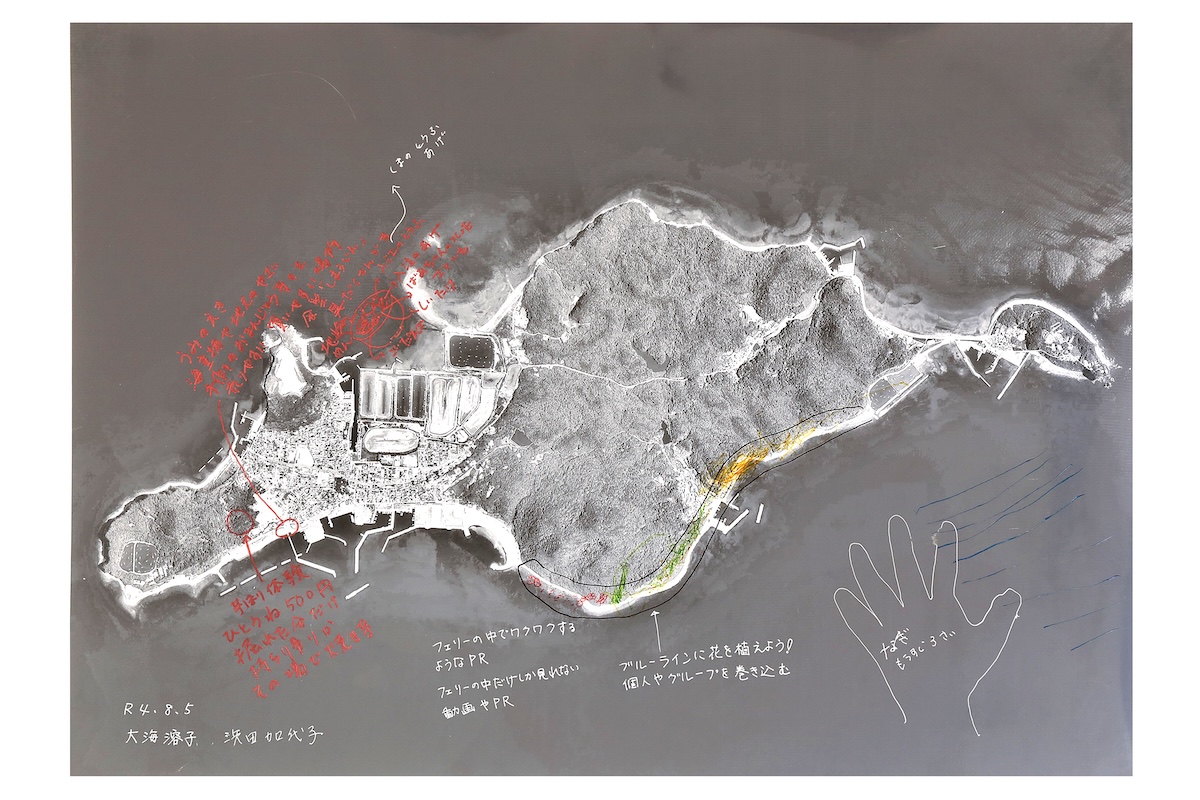
The 29 maps exhibited at the end of the project formed an atlas representing a wide range of stories and continuing to generate further dialogue and narratives. Through both the previous “Chair Project,” which collected island residents’ memories of their hometown, and the current “Atlas Project,” it remains uncertain to what extent EWS itself became a catalyst for change. Unless island residents are able to participate actively in decision-making about their hometown through means such as voting, major changes are unlikely to occur.
However, through this project, dialogue has begun, and we hope that it will continue to generate new stories and that the local administration will listen to them. At the same time, we felt that in order to observe the kinds of changes in awareness that this project sought to encourage, it would be necessary to engage with the people of the island over a much longer period of time.
“Island Atlas: Our Words Are the Future of Our Hometown” Project videos, and related projects
https://www.sea-himeshima.com/