Over the course of approximately one year, from April 2022, we conducted research on foreign communities and presented the results in the exhibition “New Authentic.” During the research process, we were able to inherit and further develop the networks and information established through projects conducted by Arts Maebashi, such as “Immig-radio” (a radio-style YouTube project featuring immigrants), which enabled us to build smooth relationships with the Vietnamese community.
One of the most striking discoveries during the research was that although sushi is considered a representative symbol of Japanese cuisine, at a major conveyor-belt sushi chain in Gunma, the store manager was Vietnamese, and most of the staff working in the back kitchen were also Vietnamese. We were told that communication there was conducted almost entirely in Vietnamese, to the extent that learning Japanese was hardly necessary. This suggests that as immigrant populations increase, their communities become stronger, while at the same time, a separation from the surrounding local community can emerge. Even though sushi symbolizes Japanese food culture and is sustained in practice by foreign workers, a disconnect from Japanese culture itself is occurring.
For the exhibition, Yusuke Shibata worked in an actual factory employing international students and presented a performance and video work based on that experience. Building on the workshops, four food stalls were also set up at the venue (Shibata provides a detailed account in the text below). The stalls attracted many visitors, and all 300 prepared meals sold out. Through this experience, we strongly realized that “food” can function as a highly effective medium for understanding different cultures.
Because projects promoting multicultural coexistence require continuity, we hope to continue these practices in the future.
(Takayuki Yagi, Maebashi Art Practice NPO)
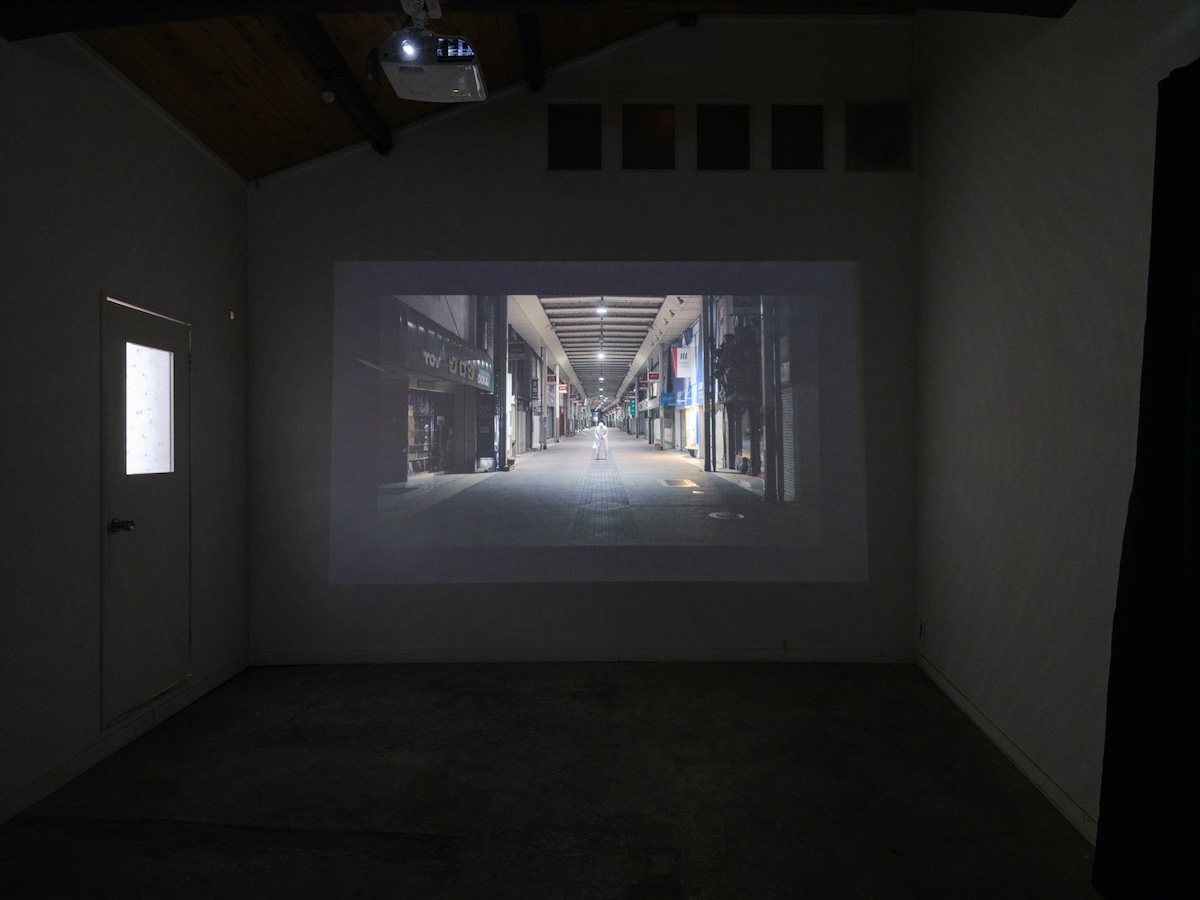
Installation view of Yusuke Shibata’s work at the exhibition “New Authentic”
I occasionally researched foreign communities in Japan for a year, starting in April 2022. Through speaking with foreign residents not only in Maebashi, Gunma, but also across various parts of Northern Kanto from different national backgrounds, I came to understand the circumstances surrounding foreign residents in Maebashi, the primary focus of this project, more comprehensively.
Our society is sustained by foreign workers who support many of the “backstage” aspects of everyday scenes in Japan. During this research, I learned a surprising fact that the manager of a conveyor-belt sushi restaurant in Gunma Prefecture was Vietnamese. Now that the Vietnamese not only supported the “backstage” of Japanese society, but also managed sushi restaurants, representing the Japanese national food, I thought perhaps I should enter the “backstage” of Vietnamese restaurants instead. Although I approached more than five restaurants offering to work voluntarily, they all turned down my request. From this experience, alongside many others, I faced the difficulty Japanese people and foreign residents often find in crossing into one another’s social and cultural spheres.
In the exhibition showcasing the result of this project, “New Authentic,” a report of my experience as an undercover part-time worker at a prepared-food factory in Kumagaya, Saitama Prefecture, where many Vietnamese workers are employed through temporary staffing agencies, and video work based on that experience. In addition, the exhibition featured four food stalls set up in front of the gallery, serving handmade udon and Vietnamese cuisine as the exhibition’s main event.
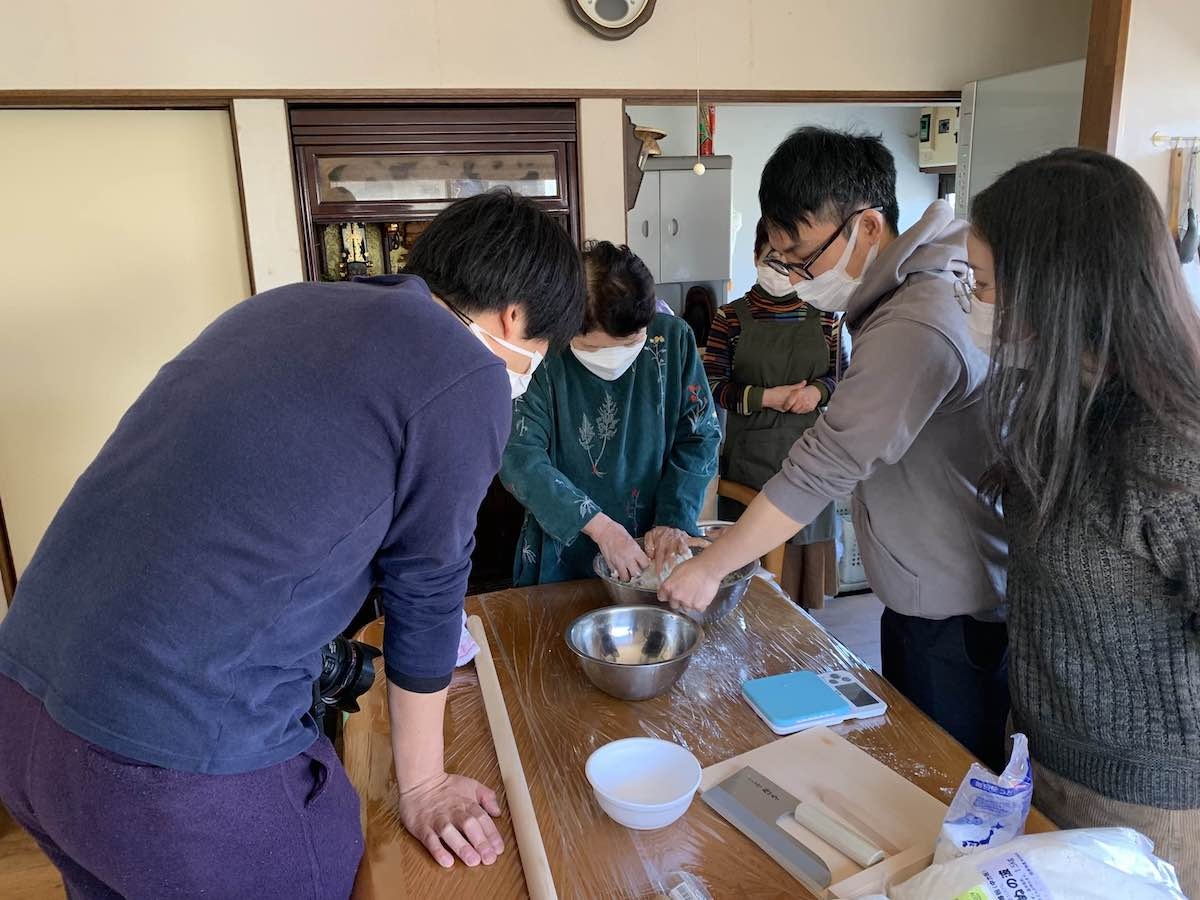
Thao and Nguyễn, two Vietnamese participants in the project, learned udon-making, part of Gunma’s rich flour-based food culture, at local households in Maebashi. They each served different types of handmade udon using different flours, thicknesses, and noodle styles, from two Vietnamese-style street food stalls. The menus, prices, and signs were written entirely in Vietnamese. The intention was to represent that they served the Japanese traditional food as the “new authentic” Vietnamese cuisine, rather than as food cooked by those in the “background” of a Japanese business. Likewise, the Japanese participants operated their stalls through a similar process of cultural exchange. Shibata prepared “bún bò Huế” (Vietnamese beef noodle soup), which he learned from a Vietnamese student from Huế, while Nyamcom, a resident of Maebashi, cooked “nem rán” (fried spring rolls), which she learned from Thao. These dishes were then served from two Japanese-style stalls.
Just as Chinese workers, who were once the main labor force among the foreign workers in Japan, gradually disappeared as Vietnamese workers replaced them, Vietnamese workers may leave Japan one day as Vietnam’s economy continues to develop. The Vietnamese restaurants currently opening one after another across Japan may also disappear in time. Yet if Japanese people inherit these flavors and culinary traditions, perhaps the food culture shaped by the Vietnamese climate and customs could someday become reinterpreted as a “new authentic” Japanese cuisine—just as tempura, which had originally been introduced from Portugal alongside firearms, became one of Japan’s representative dishes. Even if Vietnamese communities eventually leave Japan, there may be a future where these culinary practices remain and take root as the cuisine of the “new authentic.” By gradually approaching one another, digesting misunderstandings and cultural gaps along the way, we attempted together to imagine this as-yet-unseen “new authentic.”
(Yusuke Shibata)
[Project Credits]
Guest Artist: Yusuke Shibata Coordinator: Toshihiro Fukunishi Assistant: Keiko Amamagasa Supported by: Kawamura Cultural and Arts Foundation, Maebashi City Cultural and Artistic Activities Encouragement Grant (2022) Special Sponsor: Yamato Corporation Cooperation: ya-gins, Bentena SHOP, Thao Hoang, Nguyễn Nguyên, Thanh Quang, Nhật Lệ, Thanh Tuyền, Kazuhiko Koide, Shinobu Imai, Hitoshi Imai, Shino Ishihara